An HVAC business owner called me last spring. He wasn’t struggling. He had a good reputation, twelve years in business, and a phone that rang because people told their neighbors about him.
The problem was that it rang in bursts. Three jobs in a week, then nothing for eleven days. He couldn’t hire, because he couldn’t promise anyone steady hours. He couldn’t turn down bad jobs, because he never knew when the next good one was coming. He was busy and stressed and completely at the mercy of whether somebody happened to mention his name at a barbecue that month.
That’s the actual problem most home service businesses have. Not zero leads. Inconsistent ones.
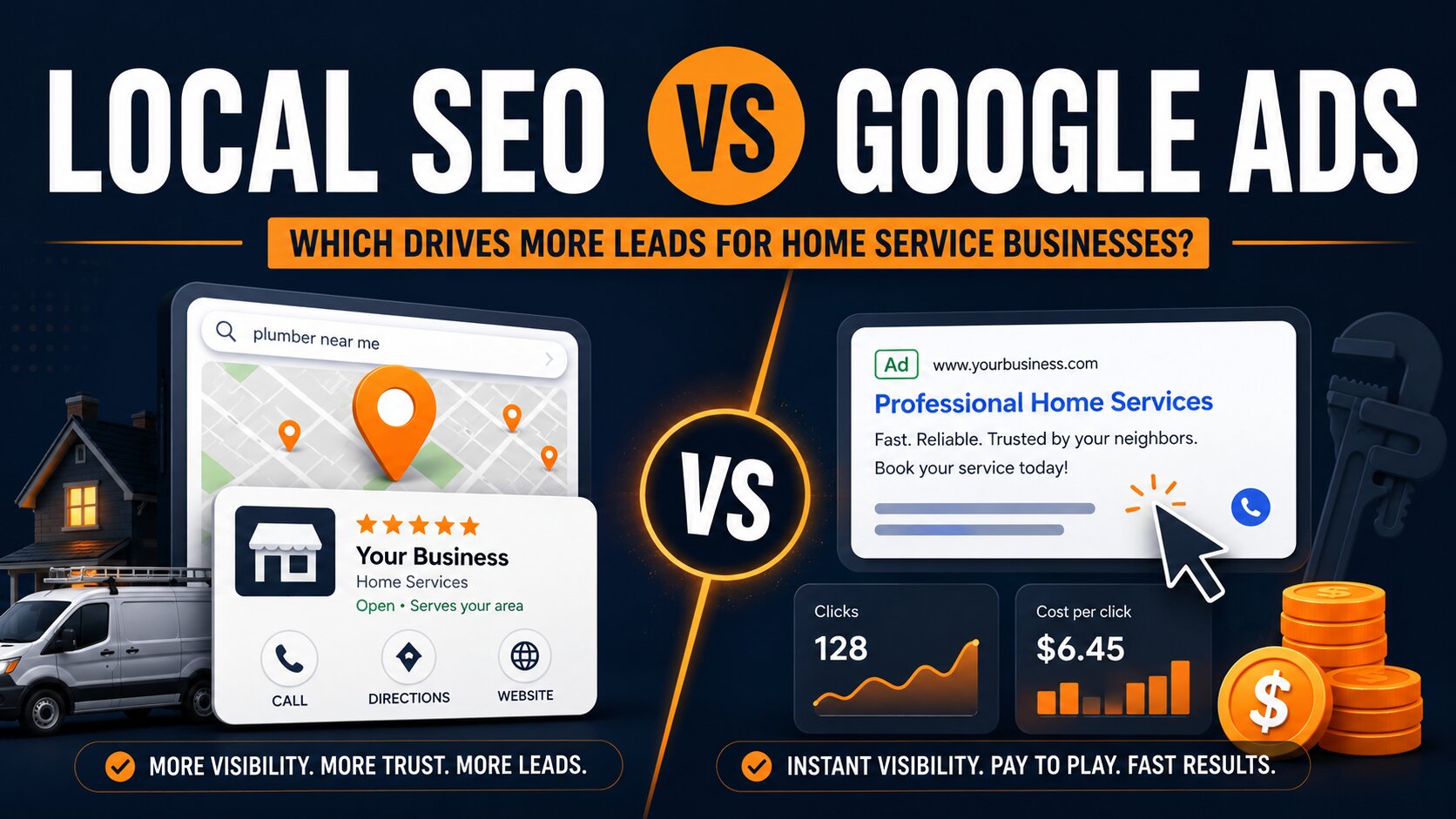
So when someone asks me whether they should put their money into Local SEO vs Google Ads, I already know they’re asking the wrong version of the question. The honest answer, and the one I give every time, is that you should run both. Ads to get consistent leads now. Local SEO to build the thing that makes you the obvious choice later. And I’ll tell you exactly why, exactly what it costs, and exactly when I’d tell you not to.
Key Takeaways
- The real problem is inconsistency, not absence. Most home service businesses already get leads from word of mouth. They just can’t predict them.
- Google Ads buys consistency, and you pay per lead. That’s the trade. It’s honest and it works, as long as the math on your job value supports it.
- Local SEO buys trust and free leads. It takes months, but at the end you show up in search without paying for the click.
- Run both. Ads carry you while SEO builds. That’s the whole strategy.
- Month six is the turning point. If it’s done right, you’re winning searches in your area and you get to choose: scale, or pull back on ads.
- Don’t run Google Ads if your job value is too low or your market is too expensive. In that case, social ads are the cheaper play.
Table of Contents
The Real Problem Isn’t No Leads
Almost every home service business I’ve worked with was already getting leads when they called me. Word of mouth. Referrals. A neighbor who saw the truck. Past customers who came back.
That’s good. Referral business is the highest-trust, highest-close-rate lead you can get. If you have it, you built something real.
But here’s what nobody tells you about referral-driven businesses: you don’t control the faucet. Leads come when they come. You can’t forecast. You can’t staff. You can’t plan a truck purchase or a hire or a slow-season buffer, because you genuinely do not know what next month looks like.
And when you’re in a dry stretch, you take the job you shouldn’t have taken. The customer who haggled. The one who’s going to be a problem. You take it because you don’t know when the next one is coming, and that fear costs you money in ways that never show up on a P&L.
So the question isn’t “how do I get leads.” You already get leads. The question is how do I get leads on purpose, on a schedule I can plan around.
That’s what this whole conversation is actually about. And the two tools that solve it work on completely different timelines, which is why you shouldn’t be picking between them.
What Google Ads Actually Buys You
Google Ads solves the consistency problem immediately. Someone in your service area searches “water heater replacement near me,” your ad shows up, they click, they call you. You can have that running this week.
The deal is simple and I’m not going to dress it up: you are paying for each lead. Every click costs money. Some clicks turn into calls. Some calls turn into jobs. You are buying customers, and Google is setting the price.
That’s not a criticism. Buying customers is a completely legitimate thing to do, and for a lot of home service businesses it’s the smartest money they spend. But you have to know what you’re getting into.
The math you need to run before you spend a dollar
Cost per click in home services is not cheap. Depending on your trade and your market, you might be paying anywhere from $8 to $50 or more per click. Emergency services and high-ticket replacements sit at the ugly end of that range.
Say your clicks cost $20. Say it takes roughly ten clicks to generate one phone call. Say you close half your calls. That’s $400 to acquire one customer.
If your average job is a $7,000 roof, $400 is nothing. Buy every lead you can find.
If your average job is a $300 service call, $400 to get it is a catastrophe. You just paid to lose money.
That’s the whole test, and almost nobody runs it before they start spending. It’s the single biggest reason people tell me “Google Ads doesn’t work.” Google Ads worked fine. The math didn’t.
What Google Ads is genuinely great at
- Speed. Days, not months. When the pipeline is empty, this matters more than anything.
- Intent. Someone typing “emergency plumber” into Google needs a plumber right now. That’s the highest-intent traffic that exists.
- Control. You pick the keywords, the zip codes, the hours of day. Want to only run for emergency searches overnight? Done.
- Learning. Two weeks of ad spend teaches you which services people actually search for and what language they use. That intelligence makes your SEO smarter. This is genuinely underrated.
The catch, and it’s a big one: the day you stop paying, you disappear. Not gradually. Immediately. Everything you built goes to zero the moment the card declines.
That’s why ads alone is a treadmill. It works, but you never get to stop running.
When I tell people not to run Google Ads
I don’t sell Google Ads to everyone, and here are the two cases where I’ll actively talk you out of it.
Your job value is too low. If you’re doing $250 tune-ups and cost per click in your trade is $25, the math will never work. You’d need a close rate that doesn’t exist in the real world. Don’t do it.
Your market is too expensive to compete in. Some trades in some cities have national franchises and private equity roll-ups bidding the auction into the stratosphere. If you’re a two-truck operation trying to outbid a company with a nine-figure marketing budget, you will lose, and you’ll lose expensively.
In either of those cases, I’d point you toward social ads instead. Meta ads are dramatically cheaper per click. The intent is lower, because someone scrolling Facebook wasn’t looking for a plumber, so those leads need more work to close. But they’re leads you can actually afford to buy, and a lead you can close is worth more than a lead you can’t pay for. I’ve broken down that comparison in detail in Google Ads vs Meta Ads.
If Google Ads is right for you, our Google Ads management is built around home service lead gen specifically. Phone calls and form fills from people in your service area who need what you do today.
What Local SEO Actually Builds
Local SEO is a completely different animal, and the difference is not “cheaper ads.” The difference is that you’re not buying leads. You’re becoming the company people find.
When someone searches for a plumber in your city, Google shows a map with three businesses at the top. Star ratings, distance, a “Directions” button. That map pack sits above the organic results and often right next to the ads.
Being in that top three is the goal, and Google has been openly clear about what drives it: relevance, distance, and prominence. That’s the ranking recipe. Everything in Local SEO is an attempt to move those three levers.
What the work actually is
- Google Business Profile. Every field completed. Right primary category. Real photos, updated. Every service listed individually. Posts published consistently. This is the highest-leverage thing in local SEO and it is completely free to do yourself.
- Reviews. Count, rating, and recency all feed prominence. A business with 84 reviews averaging 4.8 that got three new ones last week beats a business with 200 reviews from 2019. Most owners have no system for asking consistently, which is exactly why it’s an easy edge to take.
- NAP consistency. Your Name, Address, and Phone identical everywhere online. “Suite C” on your site, “Ste. C” on Yelp, nothing on Facebook. That mismatch quietly suppresses your rankings while you have no idea it’s happening.
- Service and location pages. A real page for every service and every city you serve. Not one page with a list. Real pages.
- Technical fundamentals. Speed, mobile, title tags, internal links, schema.
None of this is exciting. All of it compounds. And most of your competitors haven’t bothered, which is why so many perfectly good businesses are invisible on Maps.
What you get at the end
Two things Ads will never give you.
Trust. People know what an ad looks like. Plenty of them scroll right past. Showing up in the map pack with 90 reviews and a 4.9 rating says something an ad can’t say, and it says it to the exact customer who’s about to spend $8,000 on a new HVAC system.
Leads you don’t pay for. This is the big one. Once you rank, the calls come in and Google doesn’t charge you for them. Your cost per lead doesn’t just drop. On the marginal lead, it goes to effectively zero.
That’s the asset. An ad campaign is an expense that shows up on your P&L forever. A ranking position is something you own.
The honest timeline
Here’s where agencies lie, so let me not.
You’ll see meaningful movement somewhere between month three and month six. Faster if your profile was neglected and there’s easy ground to take. Slower in saturated markets. What you will not see is results in month one. Anyone promising that is either lying or about to buy fake reviews and get your profile suspended.
Our Local SEO program covers all of it: profile optimization, review generation, citation cleanup, location pages, technical work. The 2026 Local SEO checklist lays out the full scope if you want to see what you’d be taking on.
Why I Tell Home Service Businesses to Run Both
Now put those two side by side.
Ads gives you leads today and charges you for every one. SEO gives you leads eventually and then stops charging you. One solves your problem now. The other solves it permanently.
Picking one means either paying forever or waiting six months with nothing. Neither of those is a strategy. Running both is.
Here’s the logic, and it’s not complicated:
Ads carry you while SEO builds. You turn on ads in week one and you start getting the consistent leads you’ve been missing. That fixes the immediate problem. Meanwhile, in the background, the SEO work is happening. Profile, reviews, citations, pages. It’s not producing yet. That’s fine. It’s not supposed to.
Ads make your SEO smarter. This part gets missed constantly. Two months of ad data tells you exactly which services people search for, what words they use, and which ones actually convert into paying jobs. Then you build your service pages and location pages around real data instead of your best guess. Most agencies build SEO on hunches. You’d be building it on evidence you already paid for.
SEO eventually takes the load off Ads. Around month six, if the work was done right, you start winning searches in your area. Calls come in that you didn’t pay for. Now your blended cost per lead starts dropping, and it keeps dropping.
That’s the whole play. It’s not a bundle I invented to sell more. It’s the only version that solves both the short-term problem and the long-term one at the same time.
What it actually costs
Let me be direct about this, because most agencies won’t be.
If you do it yourself, your only hard cost is ad spend. The Google Business Profile work, the review requests, the citation cleanup, the content, all of it is free to do. The real cost is your time, and it’s not small. Local SEO takes months to learn before you’re any good at it, and you’re going to be learning it in the evenings after a full day of running a business. Plenty of owners do this. Some do it well. Just go in with your eyes open about what it actually costs you.
If you hire it out, here’s the market. Most agencies charge $1,000 or more per month to manage Google Ads, or a percentage of ad spend once you’re above roughly $5,000 a month. SEO is typically another $1,000 to $3,000 a month on top of that. So you’re often looking at $2,000 to $4,000 a month before a single dollar of ad spend.
We’re at $1,500 a month for our complete plan, which handles both. Local SEO and Google Ads management together. Ad spend is separate, and we recommend a budget based on your goals, your industry, and what your specific market actually costs. Not a template number. Everything’s on our pricing page, because I don’t think you should have to sit through a sales call to find out what something costs.
One more thing, and it matters more than the budget question. Neither channel works if your website doesn’t convert. Ads buy you a click. SEO earns you a visit. Both of them deliver a stranger to your website, and if that site has the phone number in gray text in the footer and a nine-field contact form, you paid for nothing. If that description made you uncomfortable, it might be time for a website redesign before it’s time for a marketing budget. There are a handful of other mistakes that keep businesses invisible online, and most are fixable in a week.
The First Six Months, Month by Month
Here’s what actually happens when you run both, so you know whether it’s working.
Month 1: Ads on, foundation laid
Ads go live on your highest-margin service in your tightest geography. Not everything, everywhere. One thing, one place. You start getting calls within days.
At the same time, the free stuff gets fixed. Google Business Profile completed top to bottom. Review request system set up. Citation audit started.
Expect ad performance to be rough this month. Every account wastes money in month one on bad keywords and junk clicks. That’s not failure. That’s the cost of learning what a lead actually costs you.
Month 2: Ads tighten, SEO grinds
Now you have real data. Bad keywords get cut. Negative keywords get added. Cost per lead starts dropping and consistency starts showing up. This is usually when the feast-or-famine cycle first starts to break.
SEO is invisible right now. Citations getting cleaned, reviews trickling in, service pages getting built. Nothing to see. Keep going.
Month 3: The hard month
This is where people quit SEO. Ads are working, SEO isn’t showing anything, and it starts feeling like you’re paying for nothing.
You’re not. Month three is exactly when the foundation is nearly set and results are close. Everybody who quits, quits here. Don’t.
Month 4: First organic movement
You start creeping into the map pack for a few terms. A call comes in and you didn’t pay for it. It’s a trickle, not a flood. But it’s real, and it’s the proof the machine is working.
Month 5: Momentum
Reviews are accumulating. Rankings are climbing. Organic calls go from occasional to regular. Your blended cost per lead starts visibly dropping, because some of your leads are now free.
Month 6: The good problem
If the work was done right, you’re now showing up in the top three for your core services in your primary market. Search is producing leads on its own, and they keep coming whether or not you touch anything that week.
Now you have a decision to make, and both options are good:
Scale. You have more leads than you used to and now you can plan around them. Hire the tech. Buy the second truck. Push ads into the next city over. This is the position every owner says they want and almost none of them get to on purpose.
Or throttle back. Organic is carrying your core services. Pull ad spend down and let search do the work. Use ads surgically instead: a new service launch, a slow week, a competitive keyword you can’t crack organically. Your cost of customer acquisition drops and your margin goes up.
Either way, you’re choosing. Not hoping. That’s the entire point of the last six months.
Frequently Asked Questions
Should I do Local SEO or Google Ads first?
For most home service businesses, both at once. Google Ads produces consistent leads immediately while Local SEO builds in the background. Around month six, organic search starts carrying real weight and you can decide whether to scale up or pull ad spend back. Choosing only one means either paying for every lead forever or waiting six months with nothing coming in.
How long does Local SEO take to work?
Meaningful movement usually shows up between month three and month six. Faster if your Google Business Profile was neglected and there’s easy ground to take. Slower in saturated markets where competitors have years of reviews and content built up. Anybody promising results in 30 days is either lying or planning to do something that will get your profile suspended.
When should I not run Google Ads?
Two cases. If your average job value is too low, the math doesn’t work. Paying $400 to acquire a $300 job is just paying to lose money. And if you’re in a market where national franchises have bid the auction sky-high, a small operation can’t win that fight. In either case, social ads are the better move. The intent is lower, so the leads take more work to close, but they cost far less and a lead you can afford beats a lead you can’t.
What does it cost to run both Local SEO and Google Ads?
If you do it yourself, ad spend is your only hard cost. The SEO work is free to perform, but it takes months to learn and real hours to maintain. If you hire it out, most agencies charge $1,000 or more for Google Ads management and another $1,000 to $3,000 for SEO, so $2,000 to $4,000 a month before ad spend. Our complete plan is $1,500 a month and covers both, with ad spend budgeted separately based on your goals and market.
Can I do Local SEO myself?
Parts of it, and you should regardless of who you hire. Claiming and fully completing your Google Business Profile, adding real photos, listing every service individually, and asking every happy customer for a review are all free and you can start this week. Where it gets hard is technical site work, citation cleanup at scale, and building out location page architecture properly.
I already get leads from word of mouth. Do I need this?
If those leads are steady enough to staff and plan around, maybe not. But most referral-driven businesses run in bursts: three jobs one week, nothing for the next two. That unpredictability is what costs you. It stops you from hiring, and it pushes you into taking jobs you should have turned down. The point of running both channels is to make your lead flow something you can forecast instead of something you wait for.
Your Next Step
Before you spend a dollar on either channel, find out where you actually stand. Not where you assume you stand. Is your Google Business Profile complete or missing half its fields? Are there three different versions of your phone number floating around the internet? Do you rank on page one, page four, or nowhere at all? What are your competitors already doing that you aren’t?
You can’t make a smart decision without that information, and most owners have never had anyone actually look.
That’s what our free Online Visibility Audit is. We go through your Google Business Profile, your local rankings, your citations, your site, and your competitors. Then we tell you exactly where you’re losing visibility and what your first move should be. No pitch, no pressure. Just a straight answer about where you stand.
If you already know what you need, our pricing is public and you can see the full scope on our services page.
But if you’re the painter with the phone that rings in bursts, start with the audit. It’s free, and it’ll tell you in a few days what it would otherwise take you six months and a few thousand dollars to figure out on your own.
Get your free Online Visibility Audit and let’s find out where you actually stand.