Let me guess. Your phone still rings. Word of mouth has carried you this far. A neighbor tells a neighbor, a past customer refers their brother-in-law, and the work keeps coming. So somewhere in the back of your mind, a small business website feels like one of those things you’ll “get to eventually.” Maybe it feels like an expense you can’t quite justify when business is fine without it.
I hear this all the time from painters, electricians, plumbers, and roofers here in the Hampton Roads area. And I’m not going to give you the tired agency answer that you absolutely must have a website or you’ll go out of business tomorrow. That’s not true, and you’d see right through it.
But here’s what is true. The customer who never calls you is invisible to you. You don’t feel the loss, because you never knew they were looking. They searched, they didn’t find you, and they called the guy who showed up first. That’s the real question behind whether you need a small business website. It’s not about whether you can survive without one. It’s about how many customers you’re quietly losing to competitors who are easier to find.
Key Takeaways
- Around 27% of U.S. small businesses still don’t have a website, and trades and home service businesses make up a big share of that group. Being findable is a competitive edge, not table stakes.
- 81% of consumers research a business online before hiring or buying. If they can’t find you, many of them won’t even give you the chance to earn the job.
- A website is your home base, not just a brochure. It’s the one piece of your online presence you actually own and control, unlike a social page or a directory listing.
- Word of mouth and a website work together. Referrals still Google you before they call. A weak or missing web presence can quietly kill a warm lead.
- You don’t need a giant, expensive site. A clean, fast, mobile-friendly site with a few key pages does the heavy lifting for most local service businesses.
- Your Google Business Profile and your website are a team. One helps you show up on the map, the other closes the sale. You want both.
The Real Question Isn’t “Do I Need One”
When a business owner asks me whether they need a website, they’re usually asking a slightly different question underneath. They’re asking, “Is this worth my money and time, or is it a nice-to-have I can skip?”
Fair question. So let me reframe it the way I actually think about it.
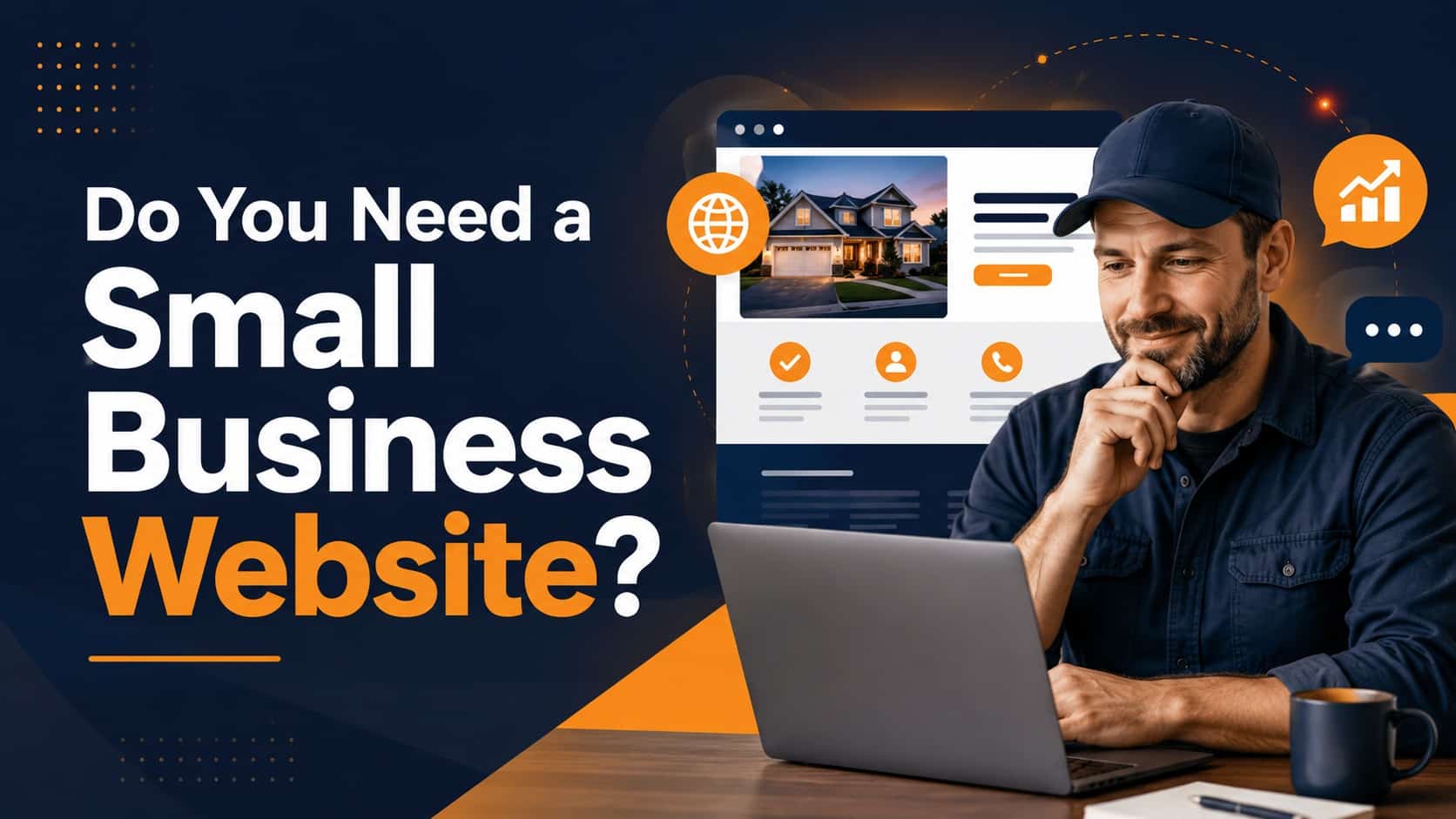
Your small business website isn’t a billboard you put up and forget. For a local service business, it’s the place a potential customer lands when they’re actively trying to decide whether to hire you. They’ve already got a problem. A leaking roof, a dead outlet, a paint job they’ve been putting off. They’re not browsing for fun. They’re in buying mode, and they’re checking you out before they pick up the phone.
At that exact moment, you either look like a real, established, trustworthy business, or you look like a question mark. There’s no in-between. And the businesses that consistently win those moments are the ones that made themselves easy to find and easy to trust.
So the honest answer to “do I need a website for my small business” is this. You can operate without one. Plenty of businesses do. But you’re playing the game with one hand tied behind your back, and you can’t see the customers you’re losing.
What the Numbers Actually Say
I don’t like throwing stats around to scare people. But a few of these are worth sitting with, because they describe your actual customers, not some abstract “market.”
Start with this one. According to Clutch’s research, 83% of small businesses now have a website, up from 64% in 2018. Flip that around and roughly a quarter of small businesses still don’t. And here’s the part that matters for you specifically. Trades and home service businesses (plumbers, landscapers, painters, roofers) are heavily overrepresented in that no-website group. Which cuts both ways. It means a lot of your competitors are still invisible. It also means the ones who do show up online stand out fast.
Now the number I really want you to remember. Roughly 81% of consumers research a business online before they use it. They’re not just looking you up after they’ve decided. They’re looking you up to decide. If a customer hears your name from a friend, sees your truck, or spots your yard sign, their next move is almost always to search you. What they find (or don’t find) shapes whether you get the call.
And people trust what they can verify. Business websites rank among the sources consumers most trust for information about a local business, right alongside Google itself. A social post can feel like marketing. Your own website, with your services, your service area, your reviews, and your real contact info, reads as the source of truth.
One more, because it’s easy to underestimate how much research people do. Most shoppers compare multiple sources before choosing, reading reviews, checking a couple of sites, and forming an impression before they ever reach out. Every one of those touchpoints is a chance to either build confidence or lose it. A website is how you control the story instead of leaving it to chance.
“But I Already Have a Facebook Page”
This is the most common pushback I get, and I understand it. You’ve got a Facebook page, maybe an Instagram, and they were free. You post a few before-and-afters, customers message you there, and it feels like enough.
Here’s the problem, and I say this as someone who actively runs social media strategy for clients. Social media is rented land. You don’t own it. The platform owns your followers, controls what shows in the feed, and can change the rules whenever it wants. Your reach one day can be a fraction of it the next, and there’s nothing you can do about it.
A website is land you own. It’s yours. Your content, your leads, your data, your rules. Nobody can throttle it or take it away. That difference matters more than most owners realize until a platform change wipes out their reach overnight.
There’s also the trust gap. When someone’s about to spend real money on a roof or rewiring a house, a Facebook page alone can leave them uncertain. Are you licensed? Insured? Do you actually serve their neighborhood? What do past jobs look like? A page makes them dig for that. A good website answers it in ten seconds.
I’m not telling you to ditch social. Use it. It’s a great top-of-funnel tool and it feeds your presence. But leaning on it as your only online home is one of the common marketing mistakes that keep local businesses invisible online. Social and a website aren’t either-or. They’re a team, and the website is your home base.
Even Your Referrals Google You First
This is the part that surprises people most, so I want to spend a minute on it.
You might be thinking, “My business runs on referrals. Word of mouth is my whole thing. Why do I need a website?” And you’re right that referrals are gold. They convert better than almost any lead source, and they cost you nothing but good work.
But watch what actually happens with a referral in 2026. Your happy customer tells their coworker, “Call this guy, he did our bathroom, he was great.” The coworker nods. Then, before they call, they pull out their phone and search your business name. That’s just reflex now. They want to see who they’re about to let into their home.
If that search turns up a clean website with real photos, clear services, and a few solid reviews, the referral gets stronger. The coworker calls already half-sold. But if the search turns up nothing, or a dead Facebook page from three years ago, doubt creeps in. Maybe they call. Maybe they get distracted, keep scrolling, and stumble onto a competitor who looks more legit. You just lost a warm lead you never even knew you had.
That’s the invisible loss I mentioned at the top. Word of mouth doesn’t replace a web presence. It runs straight through it. A website makes every referral you already earn convert better. If you want to go deeper on the discovery side of this, we broke it down in our piece on local business online visibility.
What a Website Actually Does for a Service Business
Let’s get concrete. When people picture a website, they think of a digital brochure that just sits there. That’s the old way. A website built for a local service business is a working tool. Here’s the job it does every day.
It makes you findable when people are searching to buy
When someone searches “roof repair near me” or “electrician in Newport News,” you want to be in the results. Your website is the foundation that makes that possible through local SEO. Without a site, you’re relying on your Google Business Profile alone, which helps, but leaves a lot of ranking power on the table. Pair the two and you cover far more ground.
It builds trust before you ever speak
Photos of real jobs. Clear service descriptions. Your service area. Licensing and insurance info. Reviews. This is the stuff that turns a stranger into someone comfortable inviting you to their home. Trust gets built before the phone ever rings.
It works around the clock
You’re on a job at 2 p.m. and can’t answer. But your website is showing a prospect exactly what you do, answering their questions, and giving them a way to reach you the moment they’re ready. It’s the employee who never clocks out.
It turns visitors into leads
A page built for conversion does more than list services. It guides a visitor toward one clear next step: call, fill out a form, or request a quote. This is where website design stops being about looks and starts being about results. A pretty site that doesn’t convert is just an expensive brochure.
It gives your ads somewhere to land
If you ever run Google Ads or Meta Ads, you need a strong landing page to send that traffic to. Paying for clicks that dump people onto a weak page (or worse, a Facebook profile) is money down the drain. Your website is what makes paid traffic actually pay off. If you’re weighing your options there, our comparison of Google Ads vs. Meta Ads is a good next read.
Your Website and Your Google Business Profile Are a Team
I want to clear up a common mix-up, because it costs people leads.
A lot of owners think their free Google Business Profile is the same thing as a website. It’s not, and the two do different jobs. Your Google Business Profile is what shows up in the map pack and on Google Maps when someone searches locally. It’s genuinely powerful, and it’s free, which is why we call it one of the best free marketing tools a local business has.
But the profile has limits. You don’t fully control it. You can’t build detailed service pages on it, target multiple keywords, or shape the full experience. It’s a listing, not a home. And if your profile isn’t set up right, you might not even show up. We wrote a whole guide on why your business might not be showing up on Google Maps if that’s happening to you.
Here’s how they work together. Your Google Business Profile helps you get discovered. Your website helps you close. Someone finds you in the map pack, clicks through to your site, sees the proof, and calls. Take away the website and you’ve got a discovery tool with a weak follow-through. One thing to nail across both: your name, address, and phone number need to match exactly everywhere they appear. Mismatches confuse Google and hurt your rankings, which is why NAP consistency matters more than people think.
When You Might Be Able to Wait (And When You Can’t)
I promised you honesty, so here it is. There are a few situations where a website isn’t your most urgent move.
If you’re a one-person operation, fully booked months out purely on repeat customers, and you have zero interest in growing, you can probably coast without one for a while. If your work is so hyper-local and relationship-driven that literally everyone finds you by knocking on a door, maybe you’ve got time. These cases exist. They’re just rarer than people want to believe.
Here’s when you can’t wait. The moment you want more work, more consistent work, or better-paying work, a website stops being optional. If your lead flow is inconsistent (busy one month, dead the next), that’s usually a visibility problem, and a website is the fix. If you want to run ads, you need one. If you’re competing against businesses that already rank on Google, you’re falling further behind every month you stay invisible.
Most home service businesses I talk to already get leads through word of mouth. The struggle isn’t getting any leads, it’s inconsistency. That’s exactly the gap a solid online presence closes, and a small business website is the anchor that holds it together. If that sounds like you, our take on building a smarter digital marketing strategy lays out how the pieces fit together.
What a Good Small Business Website Needs
Let’s kill a myth. You do not need a massive, twenty-page, expensive website. In fact, most of the time, bloated sites hurt more than they help. For a local service business, a focused, well-built site beats a big, messy one every time.
Here’s what actually matters:
- Fast and mobile-first. The majority of your visitors are on their phones, often standing in front of the problem they need solved. If your site is slow or clunky on mobile, they bounce. Speed and mobile experience aren’t optional.
- Clear services. Spell out exactly what you do and where you do it. Don’t make people guess whether you handle their kind of job or serve their town.
- Obvious contact options. Your phone number should be visible everywhere and tap-to-call on mobile. Add a simple quote form. Remove every ounce of friction between “interested” and “reaching out.”
- Real proof. Photos of actual jobs, honest reviews, and any licensing or insurance details. This is what converts a nervous first-timer into a paying customer.
- Built to be found. Structured for local SEO from the ground up so you can actually rank for the searches that bring you work.
That’s it. A handful of pages done right. If you’ve got an old site that’s slow, ugly on phones, or just hasn’t aged well, that’s worth addressing too. We covered the warning signs in our post on when it’s time for a website redesign.
How Much Does It Cost, Really
Cost is usually the real hesitation hiding behind “do I need a website.” So let me be straight with you.
The good news is that cost is less of a barrier than it’s ever been. The tools and templates available today mean you can get a professionally designed WordPress website without paying for a fully custom build from scratch. You’re not choosing between a five-figure agency project and nothing. There’s a sensible middle that fits a local service budget.
The way I think about it: a website isn’t an expense, it’s an asset that earns. If a single roofing job is worth several thousand dollars, and your site brings in even one extra job a month that you’d otherwise have lost, it’s paid for itself many times over. That’s the math that matters, not the sticker price.
We keep our pricing transparent and matched to your actual goals, and we’re big believers in doing this smart rather than expensive. If budget is tight, we wrote a whole guide on digital marketing on a budget that shows how to get real results without overspending. The point is, “I can’t afford it” is rarely the true barrier anymore. “I didn’t know it was this doable” usually is.
Frequently Asked Questions
Do I need a website if I already get plenty of referrals?
Yes, and here’s why. Your referrals almost always search your business name before they call. A website makes those warm leads convert better by giving them the proof and confidence they’re looking for. Without one, you risk losing referrals to competitors who look more established online. A website doesn’t replace word of mouth. It strengthens it.
Isn’t a Google Business Profile enough on its own?
A Google Business Profile is essential and free, and it helps you show up on Google Maps and in local results. But it’s a listing, not a small business website. You don’t fully control it, you can’t build out detailed service pages, and it limits how well you can rank and convert. The profile helps people discover you. Your website helps you close the sale. You want both working together.
Can’t I just use my Facebook or Instagram page instead?
Social media is powerful for staying visible, but it’s rented land. The platform owns your audience and controls your reach, and it can change the rules anytime. A website is an asset you own outright. It also builds more trust for high-value services, since customers can verify your licensing, service area, and past work in seconds instead of digging through a feed.
How much does a website cost for a small service business?
Less than most owners expect. With professionally designed WordPress templates, you don’t need a costly fully custom build to get a clean, fast, effective site. The better way to think about it is return on investment. If one extra job a month more than covers the cost, the site pays for itself quickly. Transparent, goal-matched pricing makes it easier to find the right fit for your budget.
How long until a website actually brings in leads?
It depends on your approach. If you pair the website with Google Ads, you can start driving traffic and leads almost immediately. On the organic local SEO side, it’s more of a build. Many local businesses see momentum pick up meaningfully around the six-month mark as rankings and reviews compound. The smart play is usually to run ads for immediate leads while your SEO builds in the background.
What if my current website is old and outdated?
An old, slow, or non-mobile-friendly site can actually work against you by making a poor first impression and hurting your search rankings. If your site is more than a few years old, loads slowly, or looks broken on a phone, a refresh is usually worth it. A modern, conversion-focused rebuild often pays for itself through the leads it recovers.
Find Out Where You Stand
Here’s the thing about invisible losses. You can’t fix what you can’t see. So before you decide whether a small business website is worth it, it helps to know exactly where your business stands online right now. How you show up in search. What customers find when they Google you. Where you’re leaking leads to competitors.
That’s exactly what our free Online Visibility Audit shows you. No pressure, no obligation, no jargon. Just a clear picture of your current online presence and the specific gaps costing you customers. Whether you’re starting from zero or you’ve got a site that’s underperforming, you’ll walk away knowing your real situation and what to do about it.
Get your free Online Visibility Audit here. It takes a couple of minutes, and it might just show you the customers you’ve been missing.
And if you’re ready to think bigger picture, take a look at everything we do to help local businesses get found and get hired on our services page. This is the work we do every day for painters, electricians, plumbers, and roofers right here in Hampton Roads. Let’s make you easy to find.