You’ve got a limited budget, a real business to run, and someone just told you to “run some ads.” Now you’re staring at two options Google Ads and Meta Ads, and you have no idea which one is worth your money. That’s a fair place to be. Most local business owners aren’t marketing experts, and the agencies that are supposed to help often make this more complicated than it needs to be.
So let’s cut through it. I’m Steven Rodriguez, founder of AdRize Digital, and I’ve managed paid ad campaigns for local businesses across Hampton Roads and beyond. In this article, I’m going to break down the real difference between Google Ads and Meta Ads and what each platform is built for, where each one shines, where each one falls flat, and how to figure out which one actually makes sense for your business right now.
What Is Google Ads and How Does It Work?
Google Ads is a pay-per-click (PPC) advertising platform. You bid on keywords, specific search terms, and your ad appears when someone searches for those terms on Google. You only pay when someone actually clicks your ad.
For a local business, this looks something like:
- A homeowner in Newport News types “painter near me” into Google
- Your Google Ad appears at the top of the results
- They click, land on your website or landing page, and call you
That’s the basic loop. It’s not complicated in concept, but it does require proper setup, keyword strategy, and a landing page that actually converts. More on that in a minute.
Google Ads also includes display ads (banner ads across websites), YouTube ads, and Google Local Services Ads but for most local businesses just getting started, Search Ads are where to begin. That’s where the high-intent traffic is.
What Are Meta Ads and How Do They Work?
Meta Ads run across Facebook and Instagram. Unlike Google, where people are actively searching for something, Meta puts your ad in front of people based on who they are; their age, location, interests, behaviors, and demographics.
Nobody on Facebook is searching for a plumber. But if you target homeowners in Chesapeake between 35 and 55 who’ve shown interest in home improvement, you can get your ad in front of a relevant audience and create demand that didn’t exist 30 seconds before.
Meta Ads tend to work better for:
- Awareness and visibility campaigns
- Retargeting people who’ve already visited your website
- Promoting special offers or events
- Building a local audience who recognizes your brand
They can absolutely drive leads but the pathway from ad to conversion typically takes a few more steps than a high-intent Google search click.
The Core Difference: Intent vs. Interruption
Here’s the simplest way to think about this:
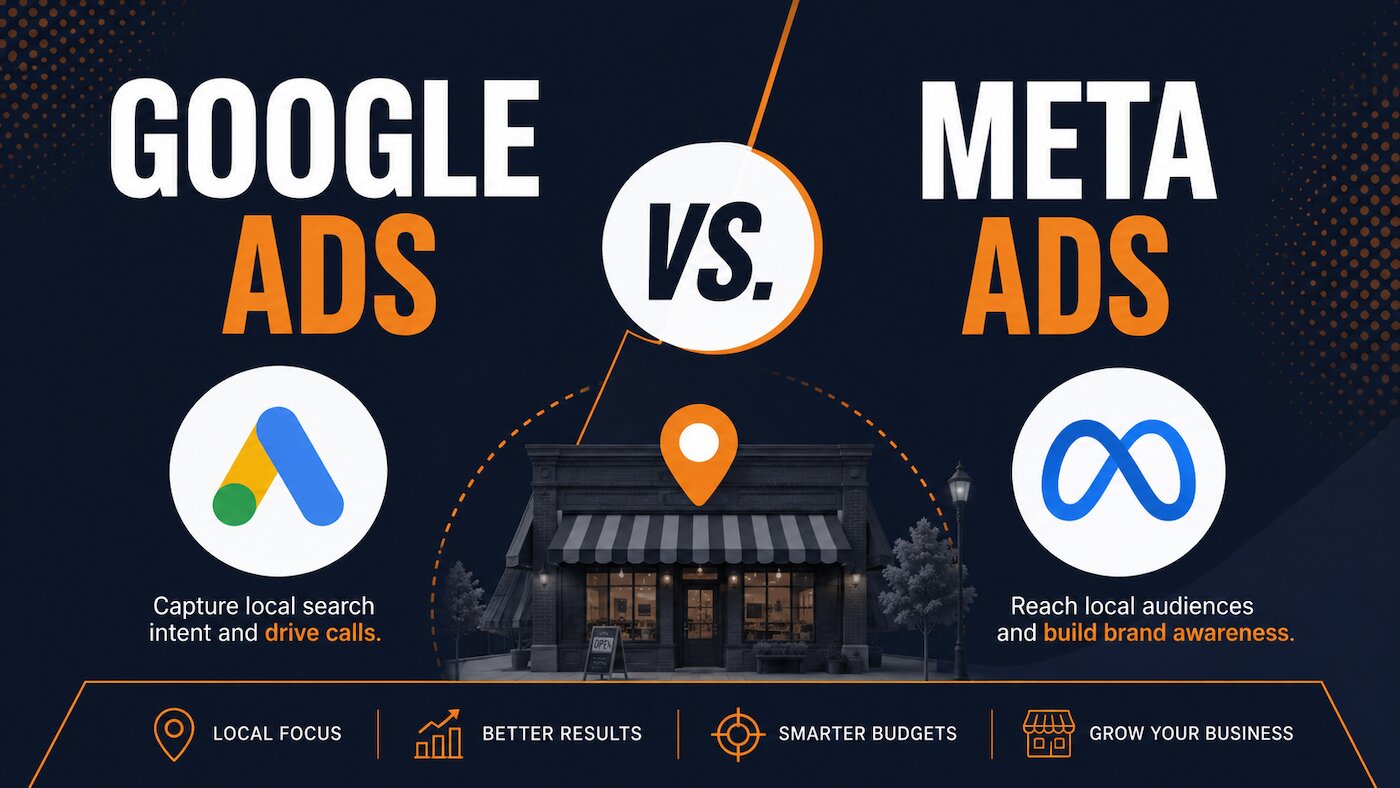
Google Ads captures demand. Meta Ads create demand.
When someone searches “emergency plumber Hampton Roads,” they need help right now. They’re ready to call. Google lets you show up at that exact moment. That’s demand capture, meeting someone where they already are in their buying journey.
Meta works differently. You’re interrupting someone mid-scroll, mid-video, mid-conversation. They weren’t looking for you. Your job is to get their attention, make them care, and eventually get them to take action. That’s demand creation and it takes longer to convert.
Neither approach is wrong. But understanding this distinction is the starting point for figuring out which platform belongs in your strategy and when.
When Google Ads Is the Right Call for Local Businesses
If you’re a local service business like a painter, electrician, plumber, roofer, HVAC tech, landscaper then Google Ads is almost always where you should start. Here’s why.
People are already searching for you. The intent is there. According to LocaliQ’s 2026 search advertising benchmarks, 88% of searches for a local business result in a call or visit. That’s not a maybe — that’s a buyer actively looking for what you offer.
The data backs this up across the board. The average conversion rate in Google Ads in 2025 was 7.52%, with automotive repair, service, and parts businesses hitting conversion rates as high as 14.67%. For home services specifically, home services businesses averaged a 7.33% conversion rate with a cost per lead around $90.92 in 2025 — numbers that hold up well when you consider the lifetime value of a single new customer.
Google Ads is especially strong when:
- Your service is urgent or time-sensitive (roof leak, broken AC, flooded basement)
- You’re in a competitive local market and need visibility fast
- Your local SEO is still building and you need leads now
- You have a clear, high-value service with a defined cost per job
One more thing worth noting: Google captures existing demand by targeting users with high search intent, and with 89.85% of global search traffic flowing through Google as of early 2025, the scale of that intent is hard to ignore.
If you want to explore what a Google Ads campaign looks like for your business specifically, take a look at our Google Ads management services.
When Meta Ads Makes More Sense
Meta Ads aren’t the wrong tool they’re just the wrong first tool for most local service businesses. That said, there are real situations where Meta makes a lot of sense.
You’re trying to build local brand awareness. If you’re newer to an area or your business doesn’t have strong name recognition yet, Meta can get your face and brand in front of a local audience repeatedly. Familiarity builds trust, and trust drives calls even if it takes a few more weeks than a Google search click.
You have a specific promotion or offer. Running a summer special on deck staining? Offering a discount for first-time HVAC maintenance customers? Meta is excellent for pushing time-sensitive offers to a targeted local audience.
You’re retargeting website visitors. This is where Meta earns its keep even for service businesses. Someone visited your website, looked at your services page, but didn’t call. A well-placed Facebook or Instagram ad showing up in their feed over the next week keeps you top of mind until they’re ready. Retargeting campaigns on Meta consistently outperform cold audience campaigns because the prospect already knows who you are.
Your service has a visual component. If you do landscape design, painting, flooring, or any work with a strong before/after Meta’s image and video ad formats can do a lot of heavy lifting. Showing your work visually builds credibility in a way that a text-based search ad simply can’t.
The key caveat: Meta Ads generally need more budget and more time to optimize before you see consistent lead flow. Don’t go in expecting immediate phone calls at the same rate you’d see from Google search ads on day one.
What Does It Actually Cost?
This is the question everyone really wants answered, so let’s be direct about it.
Google Ads pricing is driven by keyword competition. For local service keywords, you’re typically looking at a cost per click (CPC) in the range of $5 to $15 or higher depending on your market and service type. Electricians and electrical contractors, for example, commanded an average CPC of $12.18 in 2025 with a strong 9.08% conversion rate. The more competitive the keyword and the more populated your metro area, the higher the click cost. That said, if your conversion rate is strong, a $10 click that produces a $500 job is still a good trade.
Meta Ads typically have lower cost-per-click entry points. In 2024, Facebook ad traffic campaigns had a 1.57% click-through rate and a $0.77 cost per click. The clicks are cheaper but the intent is lower, which means you’ll need more clicks to produce the same number of leads. Your cost per lead on Meta can end up comparable to Google once you factor that in.
A realistic minimum budget to see meaningful data from either platform:
- Google Ads: $500–$1,000/month for a local service market, just to gather enough data to optimize
- Meta Ads: $300–$500/month at a minimum, though $700+ starts to give you more testing room
Spending below these thresholds tends to produce too little data to make good decisions and can lead business owners to write off platforms that could actually work with the right setup.
If budget is a serious constraint right now, read our post on digital marketing on a budget before you commit to either platform.
Do You Need Both?
Maybe but not necessarily at the same time, and not with the same budget split.
For most local service businesses starting out with paid ads, the right move is to go deep on one platform before spreading budget across two. Here’s the framework I recommend:
Phase 1: Start with Google Ads if your service is search-driven and you need leads now. Build your campaign properly, let it run for 60–90 days with enough budget to generate data, and optimize from there.
Phase 2: Once Google is producing consistent leads, layer in Meta specifically for retargeting and brand awareness. This is where the two platforms start to work together. Google gets the high-intent clicks; Meta keeps you in front of the people who didn’t convert the first time.
Phase 3: If you have an offer or promotion to push, add a cold Meta campaign on top of your retargeting. Now you’re running a full funnel; awareness, intent capture, and follow-through.
For marketers, what matters is understanding which part of the customer journey each platform serves best for your business and how the economics of that journey are changing. Google is still the primary engine for capturing existing demand. But demand capture has a ceiling. Meta helps you push past that ceiling by creating new demand and staying visible to warm audiences.
The businesses that win long-term are using both just in the right order, with the right budget behind each.
Your Website Matters More Than You Think
Here’s something no one wants to hear, but it needs to be said: the platform doesn’t matter if your website doesn’t convert.
It doesn’t matter whether you’re sending traffic from Google or Meta. If someone clicks your ad and lands on a slow, cluttered, or confusing website with no clear call to action — they’re gone. You just paid for a dead-end click.
Before you spend a dollar on ads, make sure your website is doing its job:
- Loads fast on mobile (most of your traffic will be mobile)
- Has your phone number visible at the top of every page
- Clearly states what you do, where you do it, and why someone should call you
- Has a simple contact form or click-to-call button
If your site doesn’t meet those basics, you’re not ready to run ads. You’re just paying to expose a weakness. We’ve written about this before: if you’re wondering whether it’s time for a website redesign, the answer is probably yes if your current site is more than three years old or wasn’t built with conversion in mind. Our website design services are built specifically for local businesses that need a site that works — not just looks good.
Common Mistakes That Waste Your Ad Budget
I’ve seen these play out repeatedly, and they’re avoidable.
Running ads without a defined goal. “More leads” isn’t a goal. “Ten new calls per month from Google Ads at under $60 per lead” is a goal. Know your numbers before you start.
Targeting too broad an audience on Meta. “Everyone in Hampton Roads aged 25–65” is not a target audience. The tighter and more defined your Meta audience, the better your results even if it feels counterintuitive to narrow it down.
Bidding on every keyword on Google. More keywords is not better. Bidding on loosely related terms burns budget fast with low-quality clicks. A tight, well-structured keyword list beats a bloated one every time.
Sending ad traffic to your homepage. Your homepage is for exploration. Your ad traffic needs a dedicated landing page built around the specific offer or service the ad is promoting. Mismatched ads and landing pages tank conversion rates.
Stopping too soon. Paid ads need time to optimize. If you run Google Ads for three weeks, get one lead, and pull the plug you haven’t given the platform enough data to learn. The first 60–90 days are the optimization window, not the proof-of-concept period.
These mistakes are exactly the kind that make business owners think “ads don’t work” when the real problem is execution. If any of these sound familiar, it might be time to take a fresh look at your overall digital marketing approach. Our post on common marketing mistakes that keep you invisible online covers more of these in detail.
And if you want to look at the broader picture of what’s making your business hard to find, our digital marketing strategy services are built around diagnosing exactly that.
Frequently Asked Questions
Is Google Ads or Meta Ads better for a small local business?
For most local service businesses like painters, plumbers, roofers, and electricians Google Ads is the stronger starting point because it captures high-intent search traffic. People actively searching for your service are far more likely to convert quickly than someone who sees your Facebook ad while scrolling. Once your Google campaigns are stable, Meta Ads become a strong complement for retargeting and awareness.
How much should a local business spend on Google Ads per month?
A realistic starting budget for a local service business is $500–$1,000 per month. Below that, you won’t generate enough clicks to produce meaningful data or consistent leads. The right number depends on your market, competition level, and the value of a new customer to your business.
Can Meta Ads generate leads for service businesses like painters or roofers?
Yes, but the process is typically slower and requires stronger creative like before/after photos, video testimonials, or compelling offers. Meta works best for service businesses when combined with retargeting (showing ads to people who already visited your website) rather than relying entirely on cold audiences.
Do I need both Google Ads and Meta Ads at the same time?
Not necessarily from day one. Start with the platform that best matches where your customers are in their buying journey. For urgent, search-driven services, that’s Google. For awareness and retargeting, add Meta once your Google campaigns are running efficiently. Splitting a small budget between two platforms too early tends to underperform on both.
What’s the biggest mistake businesses make with Google Ads?
Sending paid traffic to a homepage that isn’t built to convert. Ad clicks are expensive and every person who clicks and leaves without calling is money lost. A dedicated landing page matched to your ad’s offer and service, with a clear phone number and call to action, is non-negotiable for Google Ads to work.
How do I know if my online presence is strong enough to run ads?
Run a free Online Visibility Audit. It’ll show you where your business stands across search, your Google Business Profile, your website, and more so you know exactly what needs to be in place before you start spending on ads.
Ready to Find Out Where You Stand?
Before you spend money on Google Ads or Meta Ads, you need to know what your business looks like online right now. Are you showing up in local search? Is your Google Business Profile optimized? Does your website convert traffic into calls?
That’s exactly what our free Online Visibility Audit is designed to show you.
We’ll take a clear look at your current online presence from search visibility, website performance, to local listings and more. Then give you honest, specific feedback on what’s working and what’s holding you back.
No pitch. No pressure. Just a real look at where you stand and what your next move should be.
Get Your Free Online Visibility Audit
If you want to dig deeper into what we offer before you request the audit, you can browse our full services or view our pricing. And if you’ve been wondering whether your local SEO foundation is solid enough to support a paid ad campaign, start here: 2026 Local SEO Checklist.
When you’re ready, we’re here.