You either signed a local SEO agreement and you’re staring at the calendar, or you’re about to sign one and you want to know what you’re actually buying. Either way, the question in the back of your mind is the same: When does my phone start ringing?
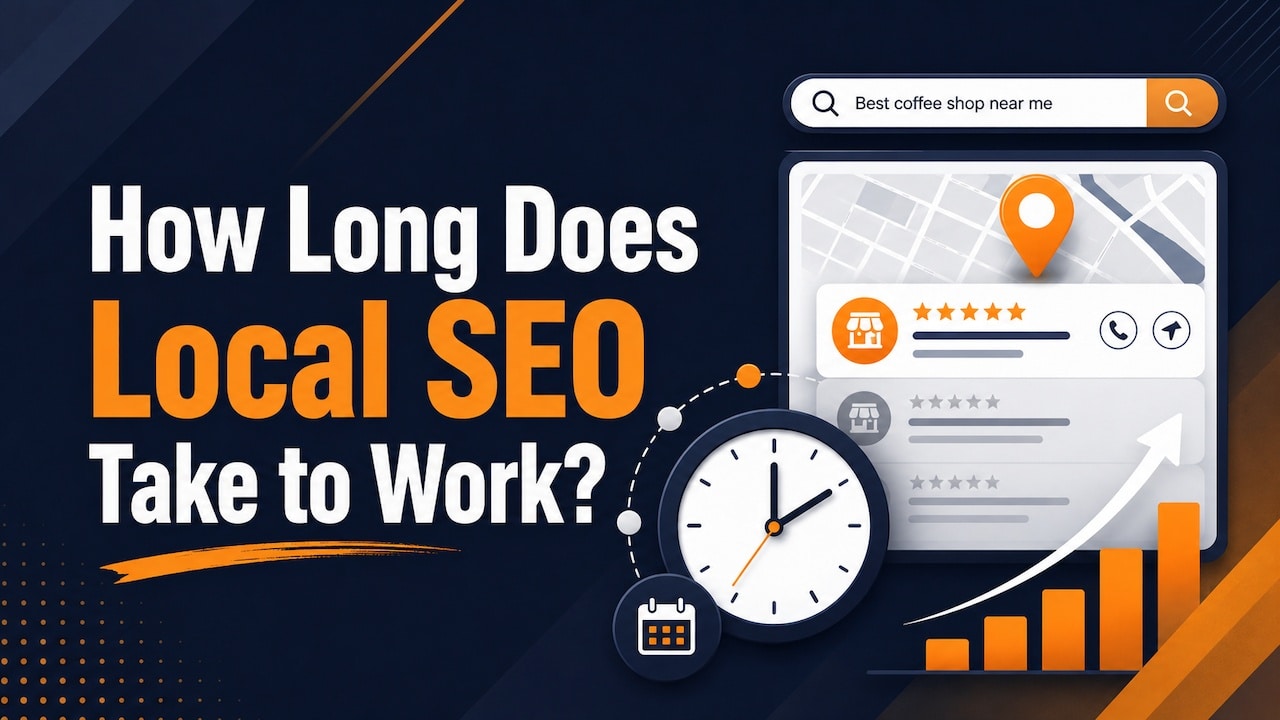
I get asked this on almost every sales call. And I’ll tell you what I tell them, because the honest answer is more useful than the comfortable one. Local SEO is not a switch you flip. It’s a position you take in your market, and positions take time to earn. Most local businesses I work with start seeing real movement in 90 days and start seeing real lead volume between month four and month six.
That’s the short version. But “three to six months” is a useless answer if you don’t know what’s happening inside those months, what makes some businesses move faster, and how to tell whether your investment is actually working before the leads show up. That’s what this article is for.
Key Takeaways
- Most local businesses see meaningful local SEO results in 3 to 6 months, with compounding growth from month six onward.
- Google Business Profile moves fastest. Map pack improvements can show up in 2 to 8 weeks, well ahead of organic website rankings.
- Your starting point matters more than your industry. An established business with a clean profile and a decent website moves in half the time of a brand new business starting cold.
- Website rankings are the slow lane. Ahrefs data shows the average page ranking in Google’s top 10 is more than three years old, so patience on organic pages is not optional.
- Track leading indicators, not just rankings. Profile views, direction requests, calls, and impressions move before revenue does.
- Reviews are an accelerant. A steady flow of new reviews is one of the few levers that compounds quickly and cheaply.
- If you need leads next week, local SEO is the wrong tool. Run Google Ads for immediate volume and build SEO underneath it.
Table of Contents
The Honest Answer: How Long Local SEO Really Takes
For most local service businesses in a normal market, here’s the shape of it:
- Weeks 2 to 8: Google Business Profile visibility improves. You start showing up for more searches, especially longer, more specific ones.
- Months 3 to 4: Map pack rankings firm up for your core services in your immediate area. Calls and direction requests start climbing.
- Months 4 to 6: Organic website pages begin ranking for service and location terms. Lead volume becomes something you can plan around.
- Months 6 to 12: Compounding. Your rankings expand outward into surrounding towns and into services you weren’t ranking for at all.
Notice that this is a range, not a promise. Anyone who gives you a guaranteed date is either new at this or hoping you don’t remember the conversation in six months. Google doesn’t publish a timeline, and no agency controls the algorithm. What a good agency controls is the quality and consistency of the work, and the honesty of the reporting.
The other thing worth naming up front: “results” means different things to different owners. Ranking third in the map pack for “painter near me” is a result. Getting 40 calls a month is a different result. They’re related, but they don’t arrive on the same day. When you and your marketing partner define results differently, you end up frustrated with work that’s actually going fine. Get specific about what success looks like before month one.
Why Local SEO Isn’t Instant
Google’s local algorithm weighs three broad things: how relevant your business is to the search, how close you are to the searcher, and how prominent your business appears to be. Relevance you can fix fast. Distance you can’t change at all. Prominence is the slow one, and it’s the one that decides most competitive rankings.
Prominence is Google’s read on whether you’re a real, established, well-regarded business. It’s built from reviews, from mentions of your business across the web, from the consistency of your name, address, and phone number, from how long your profile has been active, and from how people behave when they see you in search results. None of that can be manufactured overnight, which is exactly why it works as a trust signal.
Think of it the way Google does. If a brand new profile could rocket to the top of the map pack in a week, the map pack would be worthless within a month. The delay isn’t a bug. It’s the entire point.
There’s also a mechanical delay. Google has to crawl your changes, index them, and then test them against real user behavior before it commits to ranking you differently. That testing period alone often eats several weeks. If you want a deeper breakdown of the mechanics behind visibility, we covered it in this guide to local business online visibility.
What the Data Actually Says
I don’t like making timeline claims without something behind them, so here’s the research.
On the organic side, the picture is sobering. In a study of over a million URLs, Ahrefs found that roughly 73% of pages ranking in Google’s top 10 are more than three years old, and the average page sitting at position one is about five years old. Under 2% of brand new pages in their sample reached the top 10 within their first year. That is the reality for website pages competing on broad terms.
Now, before that number discourages you, understand why local is different. Local search is filtered by geography. You aren’t competing with every plumber in America for “emergency plumber.” You’re competing with the plumbers who can actually reach the person searching. That constraint is the single biggest reason local SEO produces results in months instead of years. A well-optimized local business with a strong profile can beat a much older, much larger website inside its own service area.
On the local side, the discovery landscape is shifting fast. BrightLocal’s Local Consumer Review Survey 2026, based on a representative panel of 1,002 US adults, found that 97% of consumers read reviews when evaluating a local business, and that the share of consumers using AI tools to find local businesses jumped from 6% to 45% in a single year. Google’s share of local discovery slipped from 83% to 71% over the same period.
Two things follow from that. First, reviews are not a side project. They’re a core ranking and conversion asset, which is why building a review engine is one of the first things we set up. Second, the same signals that make you visible in Google Maps are the signals AI tools pull from when they recommend a business. A clean, active, well-reviewed profile is now doing double duty.
A Realistic Month by Month Local SEO Timeline
Month 1: Foundation and Cleanup
This month usually feels like nothing is happening, and that’s normal. The work is diagnostic and structural: a full audit of your site and profile, keyword research grounded in what people in your area actually search, competitor analysis, and the unglamorous cleanup of inconsistent listings. If your address is written three different ways across the web, that gets fixed now. We wrote about why in our post on NAP consistency and local SEO.
Your Google Business Profile also gets rebuilt this month: correct primary category, complete service list, real photos, service area, hours, and products. If your business isn’t appearing on Maps at all, this article covers the usual culprits.
Month 2: On-Page Work and Early Movement
Service pages get rewritten or built. Location pages get created where they make sense. Title tags, headings, internal links, and page speed all get addressed. Schema markup goes on. Meanwhile, your profile starts collecting posts, photos, and new reviews.
This is usually where the first data shows up. Not leads yet, but impressions. You’ll see your profile appearing in more searches, showing up for terms you weren’t ranking for at all in month one.
Month 3: The First Real Signal
Map pack positions start improving for your less competitive terms. Calls from your profile tick up. Website pages begin appearing on page two and page three for service and city combinations. If nothing at all has moved by the end of month three, something is wrong and it’s fair to ask hard questions.
Months 4 to 6: Leads Become Predictable
This is the turning point for most of our clients. Organic pages break onto page one for their target terms. Map pack rankings stabilize. Lead volume becomes consistent enough that you can staff around it instead of reacting to it. The work shifts from building to expanding.
Months 6 to 12: Compounding
Rankings spread into neighboring cities and adjacent services. The cost of each additional lead drops, because the foundation is already paid for. This is the part of local SEO that ads can’t fully replicate: the visibility you build can continue producing leads over time, although rankings still require ongoing maintenance to stay competitive. If you want the full task list, our 2026 local SEO checklist walks through it step by step.
7 Factors That Speed Up or Slow Down Your Results
Two businesses can start the same program on the same day and land in completely different places by month six. Here’s what accounts for the gap.
- Your starting point. An existing business with a claimed profile, 30 reviews, and a functioning website is months ahead of a brand new business with none of that. Established beats new almost every time.
- Competition in your market. A roofer in a dense metro with a dozen aggressive competitors will take longer than an electrician in a smaller service area. Same work, different resistance.
- Proximity to your customers. Google favors businesses near the searcher. If your address sits on the edge of the area you serve, you’ll rank well close to home and struggle further out. Content and reviews can extend your reach, but not infinitely.
- Website quality. A slow, poorly structured site caps your results no matter how good the rest of the work is. If yours is dated, it may be time for a redesign before anything else pays off.
- Review velocity. Not just how many reviews you have, but how steadily new ones arrive. Fifty reviews from three years ago is a weaker signal than fifteen from the last three months.
- Content depth. Businesses that publish consistently rank for more terms and rank sooner. One page per service is a floor, not a strategy.
- Consistency of effort. The single most common reason local SEO “doesn’t work” is that it got abandoned in month three. Stopping at month three means paying for the entire cost and collecting none of the return.
Most of the businesses I talk to are already making at least one of the common marketing mistakes that keep businesses invisible online. Fixing those first often shortens the timeline more than anything else on this list.
The Fastest Wins in Local SEO
If you want the shortest path to visible movement, focus here first.
Your Google Business Profile. It’s free, it’s the highest-leverage asset you own, and it responds faster than anything else. Complete every field. Pick the right primary category. Add real photos of real jobs. Post regularly. We broke down the full opportunity in this guide to using your profile as a free marketing tool.
Reviews. Ask every satisfied customer, every time, with a system rather than a good intention. Respond to all of them. A business that replies quickly looks active and accountable to both Google and the next person reading.
Listing cleanup. Fixing inconsistent citations is dull work with an outsized payoff. It removes friction that’s been quietly capping your rankings.
Low-competition terms first. Ranking for “kitchen cabinet painting in Newport News” is faster and often more profitable than fighting for “painter.” Specific searches convert better anyway.
What to Measure Before the Leads Arrive
Judging local SEO by lead count in month two is like judging a foundation by how much it looks like a house. Watch the leading indicators instead. They move first, and they tell you whether the trajectory is right.
- Profile impressions and searches. How often you appeared, and for what. This is the earliest signal of all.
- Search terms you’re appearing for. A widening list of queries means Google is expanding its understanding of what you do.
- Calls, direction requests, and website clicks from your profile. Direct intent actions. These climb before form fills do.
- Organic impressions in Search Console. Pages get impressions long before they get clicks. Rising impressions on page two and three means page one is coming.
- Map pack position by location. Rankings vary block to block. A single average number hides most of the story.
- Review count and recency. Recent, consistent reviews matter more than occasional bursts.
If your reporting only shows you a keyword ranking chart, you’re not getting the full picture. Ask for behavior data that shows how people are actually finding and interacting with your business.
What to Do While You Wait
Here’s the part most agencies skip. Local SEO is the right long-term play, but you still have payroll in the meantime. The answer is to run both tracks.
Google Ads can put you at the top of the results as soon as your campaign is approved and running. It still takes time to optimize targeting, keywords, and bids, but it can generate visibility and leads much faster than SEO. It costs more per lead than organic will eventually cost, but “eventually” doesn’t cover this month’s expenses. We break down the tradeoff in detail in local SEO vs Google Ads.
The strategy I recommend to most home service businesses is straightforward: start Google Ads immediately for consistent lead flow, and build local SEO underneath it at the same time. Around month six, organic typically starts carrying real weight, and you get to decide whether to scale ad spend up or dial it back. You’re never sitting in a dry spell waiting for rankings.
If ad budget is tight, or if your average job value is low enough that Google Ads math gets difficult, Meta Ads are often the better fit. And if budget is genuinely thin right now, our post on digital marketing on a budget covers what to prioritize when you can only do a few things well.
How to Tell If Your Local SEO Is Actually Working
Good signs by month three: profile impressions climbing, appearing for a wider set of search terms, calls and direction requests trending up, website pages showing up in Search Console for terms they never appeared for before, reviews arriving steadily.
Warning signs by month three: flat impressions, no new keywords, no reporting you can understand, no new content published, listings still inconsistent, and an agency that talks about “algorithm updates” instead of showing you data.
The distinction that matters is direction, not magnitude. Small numbers moving in the right direction at month three is exactly what progress looks like. Zero movement is not.
One more thing worth saying plainly. If your website converts poorly, better rankings just send more people to a page that doesn’t work. Traffic is not the finish line. A clean, fast, conversion-focused website is what turns visibility into revenue, and the fundamentals aren’t complicated.
Frequently Asked Questions
How long does local SEO take to work?
Most local businesses see early movement in Google Business Profile visibility within 2 to 8 weeks, meaningful map pack and organic improvements between months 3 and 6, and compounding growth from month 6 onward. Your starting point, market competition, and website quality determine where you fall in that range.
Can local SEO work faster than three months?
Sometimes. Established businesses with a claimed profile, solid review history, and a healthy website can see map pack improvements in 4 to 8 weeks, especially in less competitive markets or for specific, lower-volume search terms. Brand new businesses starting from zero should plan on the longer end.
Why isn’t my business showing up on Google Maps yet?
The usual causes are an unverified or incomplete profile, the wrong primary category, inconsistent name, address, and phone data across the web, too few reviews, or being physically outside the area you’re trying to rank in. Each of these is fixable, and fixing them is usually the fastest available win.
How much does local SEO cost?
Pricing varies with your market, your competition, and how much groundwork needs to be done. We publish our packages openly on our pricing page so you can see what you’re getting before you talk to anyone.
Should I run Google Ads while waiting for local SEO?
For most home service businesses, yes. Ads produce leads immediately while SEO builds. Running both means you’re not waiting on rankings to pay your bills, and around month six you get to choose whether to scale ads up or reduce them because organic is carrying the load.
What happens if I stop doing local SEO?
Rankings don’t vanish overnight, but they erode. Competitors keep publishing, keep collecting reviews, and keep earning links. Your profile goes quiet. Within six to twelve months of stopping, most businesses have given back a significant share of the ground they gained.
Do reviews really affect how fast I rank?
Yes. Review count and recency can influence how prominent and trustworthy your business appears, while owner responses help build customer confidence and show that your business is active. A steady flow of genuine new reviews can support stronger local visibility over time.
Find Out Where You Actually Stand
Everything in this article assumes you know your starting point. Most business owners don’t. They don’t know how their profile compares to the three competitors ranking above them, which listings are inconsistent, or which pages on their site are close to page one and which aren’t ranking at all.
That’s what our free Online Visibility Audit is for. No pitch, no pressure, no obligation. Just a clear picture of where your business stands in local search right now, what’s holding you back, and what would move the needle first.
Get your free Online Visibility Audit
If you’d rather talk through the whole picture first, take a look at our full range of services or our approach to digital marketing strategy. Either way, you’ll get a straight answer about what’s realistic for your business and your timeline.