Most of the business owners I sit down with already know something is off. They can feel it. The phone rings less than it did last year. A competitor whose work they know is worse keeps outranking them on Google Maps. Their website gets traffic, but almost nobody calls. What they cannot tell me is why.
That gap between “something is wrong” and “here is exactly what is wrong” is the entire reason a local SEO audit exists.
A local SEO audit is not a sales tool dressed up as a report. Done right, it is a diagnostic. It looks at every system that decides whether a customer in your service area finds you, trusts you, and calls you. Then it tells you which of those systems is leaking, how badly, and what to fix first.
I have run these for painters, electricians, plumbers, roofers, and barbershops across Hampton Roads. The findings are rarely what the owner expects. Below is what an honest audit actually surfaces, and why each finding matters more than it sounds.
Key Takeaways
- A local SEO audit checks four connected systems: your Google Business Profile, your business data across the web, your website, and your review profile. A weakness in any one of them caps the other three.
- Rankings are not one number. You rank differently in every neighborhood you serve, and most owners only ever check from their own office.
- Consumer standards jumped hard in 2026. The share of consumers who will only use a business rated 4.5 stars or higher nearly doubled in a single year.
- Inconsistent name, address, and phone data across directories is the most common finding, and the most boring to fix. It is also one of the cheapest wins available.
- Most local businesses are paying for ad clicks to cover a visibility problem they could solve structurally.
- An audit is only worth what you do with it. The output should be a prioritized sequence, not a list of 200 problems.
What a Local SEO Audit Actually Is
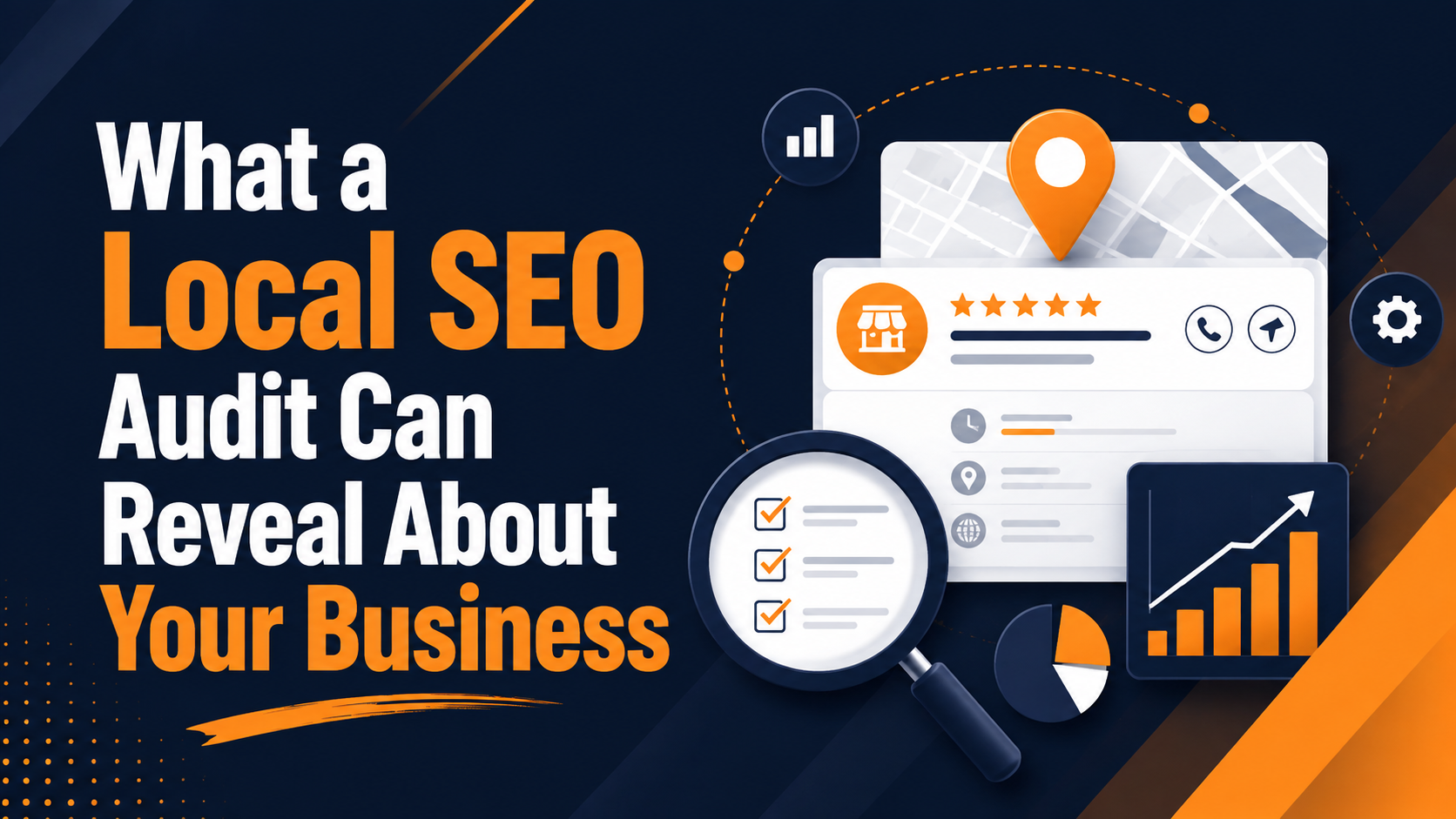
A local SEO audit is a structured review of everything that determines whether people searching for your service in your area can find you.
That is a broader scope than most people assume. It is not just your website. Google decides local rankings using signals that live in at least four different places, and most of them are nowhere near your site.
Google states plainly in its official local ranking documentation that local results are based primarily on relevance, distance, and prominence. Relevance is how well your profile matches what someone typed. Distance is how far you are from the searcher. Prominence is how well known your business appears to be, which Google says is influenced by things like how many websites link to you and how many reviews you have.
You cannot change distance. You can change relevance and prominence significantly. A good audit tells you exactly where you are weak on both.
Here is what separates a real audit from a lead magnet: a real audit is specific. “Improve your Google Business Profile” is not a finding. “Your primary category is set to General Contractor when 80 percent of your revenue is roof replacement, and the three businesses outranking you all use Roofing Contractor as their primary” is a finding. One of those you can act on Monday morning.
What a Good Audit Covers
- Google Business Profile completeness, category selection, and engagement signals
- Map pack ranking across your actual service area, not just your office address
- Consistency of your business data across directories and aggregators
- Review volume, average rating, recency, and response behavior
- Website technical health, speed, mobile experience, and conversion paths
- Service and location page coverage against the terms people search
- Competitive positioning against whoever is currently in the top three
If you want the working version of this list, our 2026 local SEO checklist walks through it step by step.
Whether You Show Up in the Map Pack at All
This is the first thing I check, and it produces the most surprise.
Most owners test their own rankings by pulling out their phone at the shop and searching their main service. They show up. They assume they are fine.
The problem is that they searched from the one location where they are guaranteed to rank: their own address. Distance is a primary ranking factor, so proximity was doing all the work.
An audit maps your visibility across a grid of points throughout your service area. A plumber in Newport News might sit at position one within a mile of the shop, drop to position seven in Yorktown, and disappear entirely in Williamsburg. That is not a ranking problem. That is a service area coverage problem, and the fix is completely different from what most people try.
The grid also reveals something more useful than your average position. It shows you where the money is being left. If you rank well in a neighborhood with low search volume and poorly in one with high volume, your effective visibility is far worse than your average suggests.
If you are not appearing at all, there is usually a specific, identifiable cause. We covered the most common ones in why your business is not showing up on Google Maps.
How Much of Your Google Business Profile Is Sitting Empty
Your Google Business Profile is the highest-leverage free asset you have, and almost nobody fills it out completely.
BrightLocal research found that only about 35 percent of small businesses even have a Google Business Profile. Among the ones that do, most set it up once and never touched it again.
An audit goes field by field. Here is what usually turns up:
- Primary category is wrong or too generic. This is the single biggest relevance lever on the profile, and it is frequently set to something broad that does not match what the business actually sells most of.
- Secondary categories are unused. You get multiple slots. Most profiles use one.
- Services are not listed individually. Every service you offer should be its own entry with a description. Empty service lists are extremely common.
- Service areas are undefined or unrealistic. Listing 40 cities does not help you. It dilutes relevance.
- Hours are outdated, including holiday hours that have not been updated in two years.
- Photos are sparse or stale. Job site photos, team photos, and truck photos all matter. Stock imagery does not.
- Products, Q&A, and Posts sit completely unused.
None of this is difficult. It is just tedious, so it does not get done. That is exactly why it is an opportunity. We broke down the full picture in why your Google Business Profile is the best free marketing tool you have.
Where Your Business Information Contradicts Itself
NAP stands for name, address, and phone number. The audit checks whether yours is identical everywhere it appears online.
It almost never is.
The usual culprits are predictable once you know to look. An old address from before you moved, still live on a directory nobody has logged into since 2019. A suite number that appears on some listings and not others. A call tracking number used in a Google Ads campaign that leaked into your Facebook page. A zip code typo in your website footer that does not match your schema markup. A business name that appears as “Smith Plumbing” in some places and “Smith Plumbing LLC” or “Smith Plumbing and Drain” in others.
Each individual inconsistency is small. Collectively they make Google less certain that all these listings describe the same business, and uncertainty suppresses prominence.
The reason this finding matters more than it sounds is the economics. There is no ongoing cost. You fix it once, it stays fixed, and it removes a ceiling that was capping everything else you were doing. Of all the work in local SEO, this has the best effort-to-outcome ratio and the least glamour. Our breakdown of NAP consistency and why it matters for local SEO covers the cleanup process.
Whether Your Reviews Still Clear the Bar
This is the section where audits have gotten noticeably harsher, because consumer expectations moved fast.
BrightLocal’s Local Consumer Review Survey 2026, based on a representative panel of 1,002 US adults, found that 97 percent of consumers read reviews for local businesses. That number has been stable for years. What changed is the standard.
In 2026, 31 percent of consumers said they will only use a business rated 4.5 stars or higher. That was 17 percent the year before. Sixty-eight percent will only use a business with four stars or more, up from 55 percent. A rating that was perfectly acceptable last year can be disqualifying now, without a single new negative review being posted.
Volume and freshness matter just as much:
- 47 percent will not use a business with fewer than 20 reviews.
- 74 percent look for reviews written in the last three months.
- 32 percent want reviews from the last two weeks, up sharply from 20 percent a year earlier.
That last set of numbers is the one that catches established businesses off guard. You can have 140 reviews and a 4.8 rating and still fail the test if the most recent one is eight months old. Review generation is not a project you complete. It is a process you run continuously.
Response behavior gets audited too. Eighty percent of consumers say they are more likely to use a business that responds to all of its reviews, and 42 percent say they are unlikely to use one that never replies. But copy-paste replies backfire: templated responses put off 50 percent of consumers. If you are pasting the same thank-you under every review, you are doing the work and getting punished for it.
If your review volume is the gap, start with how to get more Google reviews.
Where Your Website Loses People Who Were Already Interested
Here is a finding that reframes how most owners think about their site.
The same 2026 survey found that 54 percent of consumers visit a business’s website after reading positive reviews. In 2019 that figure was 32 percent. Your website is no longer where people discover you. It is increasingly where they go to confirm what they already believe about you.
That changes what the audit is looking for. It is not really a traffic question. It is a conversion question, and the failures are usually mundane:
- Load speed on mobile. Most local service searches happen on a phone, often on cellular data, often outdoors.
- Phone number is not tappable or is buried below the fold.
- No service pages. One page listing twelve services gives Google and the customer almost nothing to work with.
- No location pages for the towns you actually serve.
- Forms that ask for too much, or forms that quietly fail and never send.
- Reviews and credentials are nowhere on the site, so the trust the customer built on Google evaporates when they land.
- The site contradicts the profile, with different hours, different service areas, or a different phone number.
The last one is worth sitting with. If a customer read your reviews, decided you were probably the one, clicked through to your site, and found information that did not match, you did not lose them to a competitor. You lost them to your own inconsistency.
If the audit surfaces enough of these, the honest answer is sometimes a rebuild rather than a patch. We wrote about the signals in how to tell when it is time for a website redesign, and what a functional local business site needs in what your small business website actually needs. Our website design services are built around this exact problem.
Which Search Terms You Actually Rank For
Every owner has a list in their head of the terms they think they rank for. The audit compares that list to reality.
The gap runs in both directions, and both are useful.
On one side, you find terms you assumed you owned and do not. A roofer who is certain he ranks for roof replacement discovers he ranks for roof repair, which brings in far smaller jobs. He has been getting the volume he expected at a fraction of the ticket value, and the traffic number never told him.
On the other side, you find terms bringing in traffic that you never targeted and are not capitalizing on. Those are usually the fastest wins, because you already have partial relevance. You just have no dedicated page.
The structural finding underneath both is almost always the same: not enough pages. A business offering eight services in five towns needs real pages covering those combinations, with content that reflects how people actually describe the problem. Most local sites have a home page, an about page, a contact page, and one services page trying to do the work of twenty.
This is the core of what local SEO is meant to fix, and it is covered further in how local SEO helps people find your business.
Who Is Beating You, and What They Are Doing Differently
An audit that only looks inward is incomplete. Local search is relative. You are not being scored against a standard. You are being ranked against the other businesses competing for the same searches.
So the audit examines whoever is currently in the top three for your money terms and identifies what is different. Usually it comes down to a handful of things:
- They have significantly more reviews, or significantly fresher ones
- Their primary category is more precise than yours
- They have dedicated pages for services and towns where you have none
- They post to their Google Business Profile consistently and you do not
- They are cited across more local directories and local publications
What matters is that this converts a vague feeling into a specific gap. “They are outranking us” becomes “they have 210 reviews to our 34, and their most recent one is from yesterday.” That is a problem with a known solution and a rough timeline.
It is also worth checking honestly whether the gap is a marketing problem or an operations problem. If a competitor has three times your review volume because they ask every single customer and you never do, no amount of technical SEO closes that. Several of the issues we flag most often are in common marketing mistakes that keep you invisible online.
Whether Your Ad Spend Is Covering for a Visibility Problem
This one occasionally makes for an awkward conversation, and I would rather have it than not.
Plenty of local businesses are spending real money on Google Ads to appear for searches they should be winning organically. Ads are not the problem. Ads are a legitimate, fast, controllable channel, and we run them. The problem is when ads are quietly compensating for a structural weakness nobody diagnosed.
The tell is a specific pattern: strong paid performance, weak organic and map pack presence, and total dependence on the ad account. Turn off the spend and the leads stop within a week. That is not a marketing strategy. That is rent.
The audit also surfaces the reverse problem. If your reviews and profile are weak, your ad spend is working harder than it needs to. Traffic landing on a 3.9-star profile with 14 reviews converts very differently than traffic landing on a 4.8 with 200. Your review profile is a multiplier on every dollar of paid spend, which means fixing it improves your ad economics without touching the ad account.
The right mix is specific to your situation. We laid out the tradeoffs in local SEO versus Google Ads and Google Ads versus Meta Ads. If paid is the right lever for you, that is what our Google Ads management is for.
What to Do With the Findings
An audit that hands you 87 problems and walks away has not helped you. It has just made you anxious.
The output that matters is sequencing. Findings should be sorted by impact against effort, and the order usually looks something like this:
- Week one: Fix the things that are actively wrong. Bad NAP data, incorrect hours, wrong primary category, broken forms, missing phone links. These are corrections, not improvements, and they cost nothing but time.
- Weeks two through four: Complete what is incomplete. Fill every field on the profile, list every service, upload real photos, publish the missing service pages.
- Month two onward: Start the processes that compound. Review generation as a standing habit, profile posts on a regular cadence, new content on a schedule.
- Ongoing: Measure against your service area grid, not just your office.
Be realistic about timing. Corrections like NAP cleanup and category fixes can move things within weeks. Prominence built through reviews, content, and citations takes months. Anyone promising you page one in 30 days is selling you something. We put honest numbers to it in how long local SEO actually takes.
You can absolutely run much of this yourself, especially if the budget is tight. Digital marketing on a budget covers the DIY path. If you would rather it be handled, our digital marketing strategy work starts from exactly this kind of diagnostic, and our pricing is published openly so you can see what it costs before you talk to anyone.
Common Questions About Local SEO Audits
How long does a local SEO audit take?
A thorough audit of a single-location local business typically takes a few business days. Automated tools can generate a scan in minutes, but the analysis that makes it useful, including grid ranking across your service area and a real competitor comparison, requires manual review.
How often should I audit my local SEO?
A full audit once a year is reasonable for most local businesses. Run one sooner if you move locations, change your business name, rebrand, add a service line, expand into new towns, or see a sudden drop in calls. Review metrics and map pack position should be monitored monthly regardless.
Can I do a local SEO audit myself?
Yes, partially. Any owner can check their Google Business Profile fields, verify their NAP data on major directories, read their own reviews, and test their site on a phone. Grid-based ranking analysis and competitive gap assessment generally require paid tools and experience interpreting the results. Starting with the basics yourself is a genuinely good use of a Saturday.
What is the difference between a local SEO audit and a regular SEO audit?
A standard SEO audit focuses on your website: technical health, content, and backlinks. A local SEO audit includes all of that, then adds the signals that only affect local results, including your Google Business Profile, map pack visibility by location, citation consistency, and your review profile. For a business serving a defined geographic area, the local factors usually matter more than the website factors.
Will an audit guarantee better rankings?
No, and anyone who tells you otherwise is not being straight with you. An audit identifies what is holding you back. Results come from implementing the fixes consistently over time. What an audit does guarantee is that you stop guessing and start working on the things that actually matter for your specific situation.
See What Your Audit Turns Up
You do not need to commit to anything to find out where you stand.
We offer a free Online Visibility Audit that covers the ground above: your Google Business Profile, your map pack position across your service area, your business data consistency, your review profile, and how your website holds up against the businesses currently outranking you. You get the findings whether or not you ever work with us.
If you have been suspecting something is wrong, this is how you find out what it is.
Get your free Online Visibility Audit
Want to see the full range of what we handle for local businesses? Take a look at our services, or read how local businesses build online visibility and the 2026 marketing reset for more context on where things stand right now.